
Leadership today is no longer just about driving results. It’s about creating trust, emotional intelligence, accountability, and sustainable performance inside teams and organizations.
The most effective leaders are not simply reactive managers—they are conscious leaders. They lead with awareness, intentionality, emotional regulation, and a commitment to growth.
The 15 Commitments of Conscious Leadership provide a practical framework for leaders who want to create healthier cultures, stronger communication, and high-performing teams without burnout and disconnection.
When practiced consistently at work, these commitments help leaders move from fear-based leadership into conscious, empowered leadership.
Why the 15 Commitments Matter at Work
Many workplace challenges are not strategy problems—they are leadership awareness problems.
Teams struggle when leaders:
- Operate from stress and reactivity
- Avoid difficult conversations
- Blame others
- Resist feedback
- Lead through fear or control
The 15 Commitments help leaders create:
- Psychological safety
- Better communication
- Stronger collaboration
- More innovation
- Sustainable high performance
These commitments shift leadership from unconscious habits to intentional action.
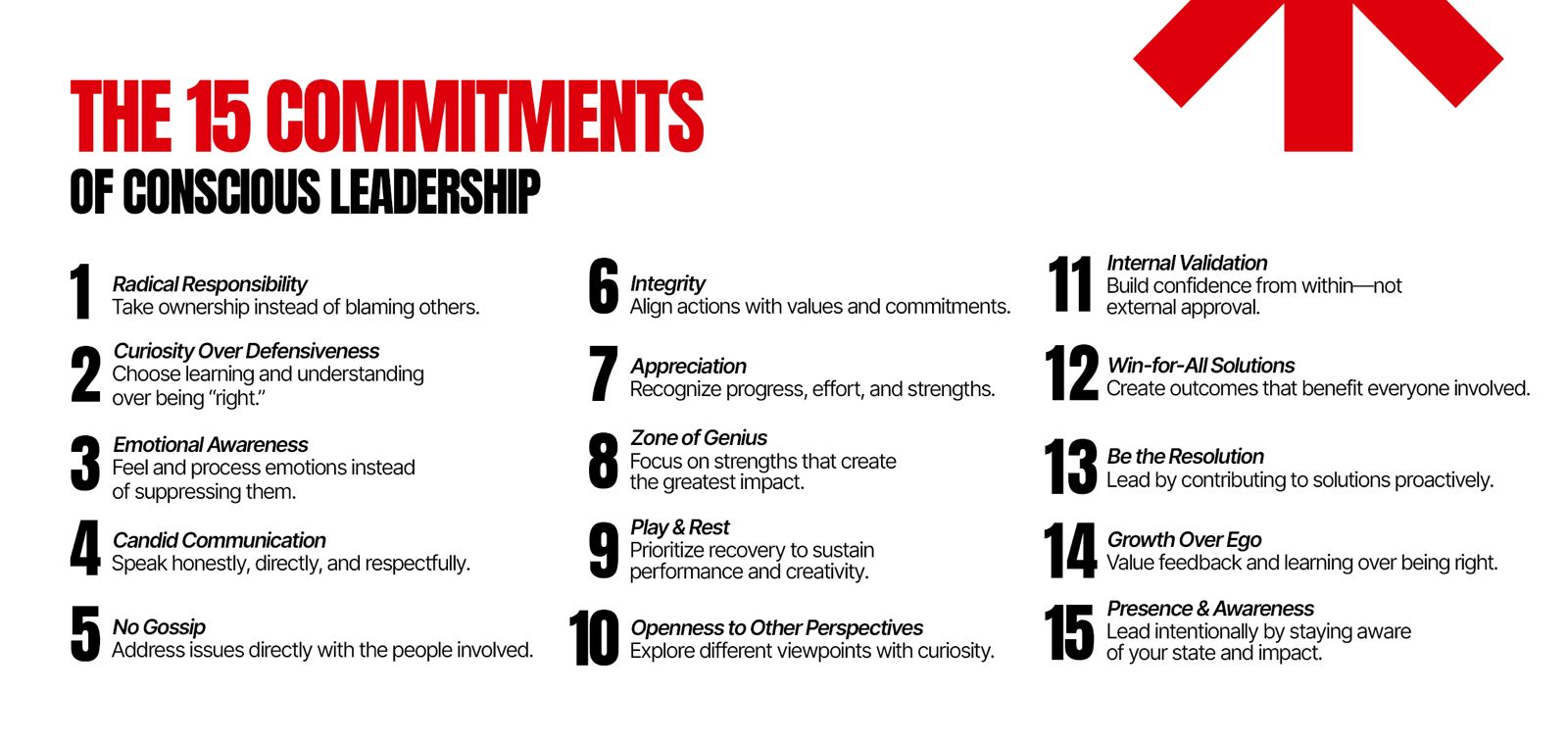
The 15 Commitments of Conscious Leadership
1. Taking Radical Responsibility
Conscious leaders stop blaming circumstances, employees, or external conditions.
Instead, they ask:
“What role am I playing in this situation?”
This commitment creates accountability, ownership, and personal growth inside the workplace.
2. Learning Through Curiosity
Reactive leaders defend themselves.
Conscious leaders get curious.
Rather than needing to be “right,” they seek understanding, ask better questions, and remain open to learning from others.
Curiosity strengthens communication and reduces workplace conflict.
3. Feeling All Feelings Fully
Many leaders suppress stress, frustration, or fear until it affects their decision-making.
Conscious leadership encourages emotional awareness instead of emotional avoidance.
Leaders who process emotions effectively create calmer, more stable workplace environments.
4. Speaking Candidly
High-performing teams require honest communication.
Conscious leaders communicate openly, respectfully, and directly instead of avoiding difficult conversations or masking truth to stay comfortable.
Candor builds trust and alignment.
5. Eliminating Gossip
Gossip weakens culture, trust, and collaboration.
Conscious leaders address issues directly with the people involved instead of discussing them behind closed doors.
This creates healthier workplace relationships and stronger team cohesion.
6. Practicing Integrity
Integrity means aligning actions with values, commitments, and words.
Conscious leaders follow through consistently and take responsibility when they fall short.
Integrity builds credibility and long-term trust.
7. Generating Appreciation
Most workplaces focus heavily on problems and performance gaps.
Conscious leaders intentionally recognize progress, effort, and strengths within their teams.
Appreciation improves morale, engagement, and psychological safety.
8. Excelling in Your Zone of Genius
Conscious leadership encourages individuals to identify and operate within their highest strengths.
Rather than working from exhaustion or obligation, leaders focus on areas where they create the greatest impact and energy.
This improves both fulfillment and performance.
9. Living a Life of Play and Rest
Burnout is not a badge of honor.
Conscious leaders recognize that creativity, innovation, and strategic thinking require recovery and nervous system regulation.
Leaders who prioritize balance often make clearer decisions under pressure.
10. Exploring the Opposite Perspective
Unconscious leadership becomes rigid and defensive.
Conscious leaders intentionally consider alternative viewpoints, even when uncomfortable.
This commitment improves adaptability, collaboration, and innovation inside organizations.
11. Sourcing Approval Internally
Many leaders operate from the need for validation, recognition, or external approval.
Conscious leadership teaches leaders to develop internal confidence and self-awareness instead of relying solely on outside validation.
This creates more authentic leadership.
12. Creating Win-for-All Solutions
Conscious leaders move beyond “me vs. them” thinking.
Instead of creating winners and losers, they seek collaborative outcomes that benefit individuals, teams, and organizations together.
This strengthens long-term workplace relationships.
13. Being the Resolution
Conscious leaders do not wait for others to fix problems.
They become proactive contributors to solutions, communication, and culture improvement.
Leadership begins with personal action.
14. Embracing Growth Over Being Right
Ego-driven leadership resists feedback and avoids mistakes.
Conscious leaders value growth more than protecting their image.
They see challenges, feedback, and discomfort as opportunities for development.
15. Leading From Presence and Awareness
The foundation of conscious leadership is awareness.
Conscious leaders pay attention to:
- Their emotional state
- Their reactions
- Their communication patterns
- Their impact on others
Presence allows leaders to respond intentionally instead of reacting impulsively.
How to Practice Conscious Leadership Daily at Work
Practicing these commitments does not require perfection. It requires awareness and consistency.
Start by:
- Pausing before reacting
- Listening with curiosity
- Having direct conversations
- Taking responsibility quickly
- Reflecting on emotional triggers
- Creating space for feedback
- Prioritizing nervous system regulation
Small shifts practiced consistently create powerful leadership transformation over time.
The Long-Term Impact of Conscious Leadership
Organizations led by conscious leaders often experience:
- Stronger employee engagement
- Healthier workplace culture
- Better communication
- Increased adaptability
- Lower burnout
- More sustainable performance
In today’s fast-changing world, leadership is no longer just about intelligence or authority.
It’s about awareness.
Because the quality of your leadership will always reflect the quality of your internal state.
Ready to Elevate Your Leadership?
If you are ready to strengthen emotional intelligence, improve performance under pressure, and lead with greater clarity and impact, conscious leadership training can help you unlock the next level of growth—for yourself and your team. Book a free consultation with us if you are ready to answer the call to conscious leadership and elevate your team’s leadership as a result.
Your highest potential is my passion, let’s unleash it together!
-Coach Susan

Susan Hobson
CEO & Founder of Elite High Performance Inc | High Performance Leadership Coach
Susan Hobson is a High-Performance Leadership Coach, published author, keynote speaker, and Founder & CEO of Elite High Performance Inc. She co-hosts The Leadership Launchpad Project podcast, ranked the #3 leadership podcast in Canada by Feedspot for two consecutive years. A member of the Forbes Coaches Council, Susan blends neuroscience with her first-hand experience competing at Princeton, Harvard, and in the NWHL to help leaders unlock sustainable peak performance.