
Leadership is about a lot more than hitting targets, staying productive, or being “in charge.” The leaders who truly earn people’s trust, bring out the best in their teams, and create strong, healthy cultures understand that real leadership goes deeper than that:
Leadership begins with self-awareness.
Conscious leadership is the practice of leading with intention, emotional intelligence, accountability, and alignment. It’s the shift from reactive leadership to responsive leadership. From control to connection. From burnout to sustainable influence.
At Elite High Performance, we’ve seen firsthand that the most transformational leaders are not necessarily the loudest or most technically skilled. They are the ones willing to do the internal work that drives external excellence.
Here are 15 foundational principles of conscious leadership — and why they matter now more than ever.
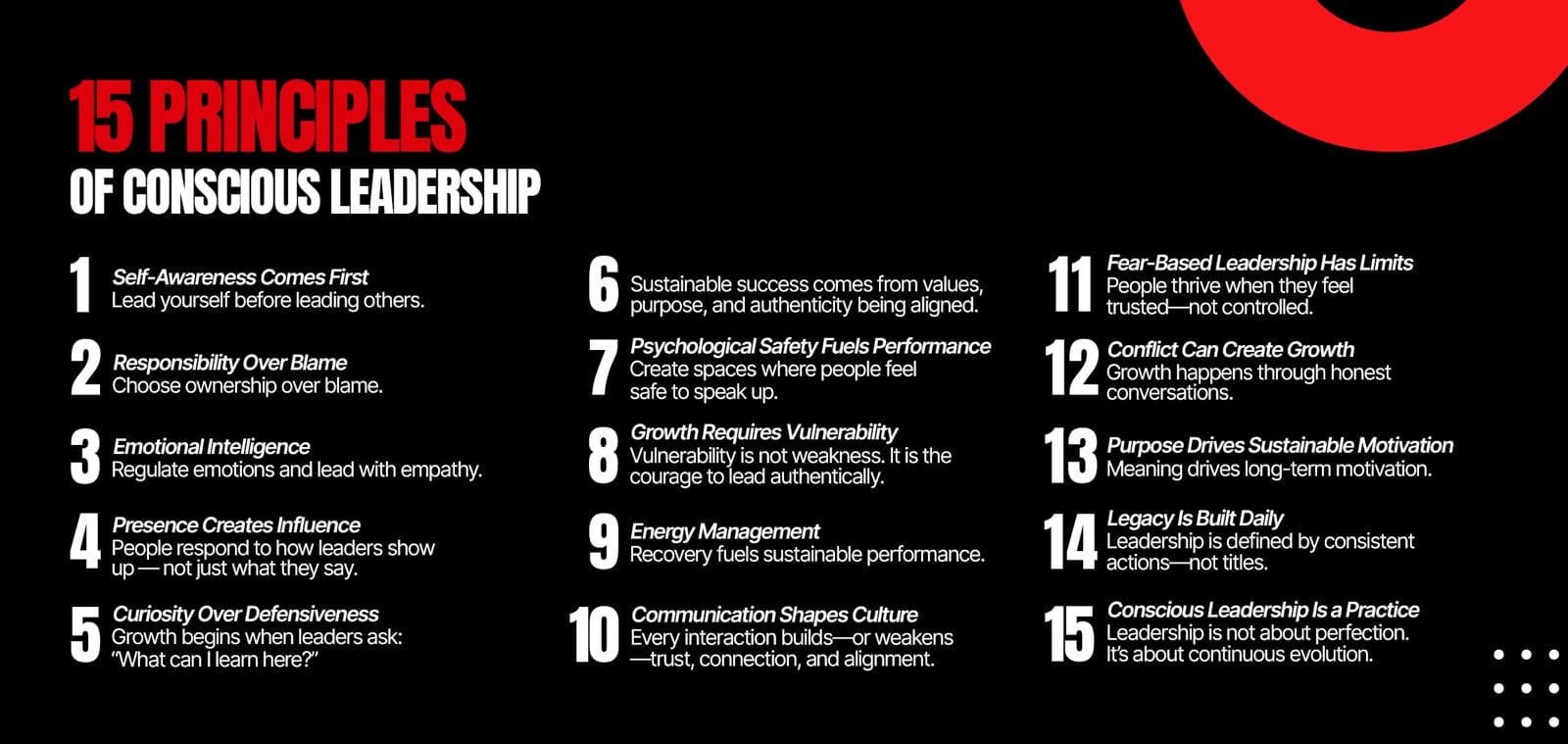
1. Self-Awareness Comes First
Conscious leaders understand that their thoughts, emotions, triggers, and habits influence every decision they make.
Rather than operating on autopilot, they pause to reflect:
- What is driving this reaction?
- Am I responding from fear, ego, or alignment?
- How is my energy impacting others?
Neuroscience shows that self-awareness strengthens emotional regulation, decision-making, and resilience. Leaders who cultivate awareness create more intentional outcomes — personally and professionally.
2. Responsibility Over Blame
Conscious leadership requires radical ownership.
Instead of blaming circumstances, teams, or external pressure, conscious leaders ask:
“What is my role in this situation?”
This mindset creates empowerment rather than helplessness. Accountability becomes a growth tool, not a punishment.
When leaders model ownership, teams feel safer doing the same.
3. Emotional Intelligence Is a Leadership Superpower
High-Achievers are often taught to suppress emotion. Conscious leaders do the opposite: they learn to understand and regulate emotions effectively.
This includes:
- Self-regulation
- Empathy
- Active listening
- Conflict navigation
- Emotional resilience
Emotionally intelligent leadership strengthens trust, communication, and team performance — especially during uncertainty.
4. Presence Creates Influence
People don’t just respond to what leaders say. They respond to how leaders show up.
Conscious leaders practice presence:
- Fully listening
- Staying grounded under pressure
- Avoiding reactive communication
- Creating psychological safety
Presence builds credibility because people feel seen, heard, and valued.
5. Curiosity Replaces Defensiveness
Defensiveness shuts down growth. Curiosity opens it.
Conscious leaders approach challenges with a learning mindset:
- “What can I learn here?”
- “What perspective am I missing?”
- “How can this experience help us evolve?”
This principle encourages innovation, adaptability, and stronger collaboration.
6. Alignment Matters More Than Image
Many leaders chase external success while internally feeling disconnected, exhausted, or unfulfilled.
Conscious leadership focuses on alignment:
- Values aligned with actions
- Purpose aligned with goals
- Leadership aligned with authenticity
Sustainable performance happens when success is built from congruence — not performance masks.
7. Psychological Safety Fuels Performance
Teams perform best when people feel safe to:
- Speak honestly
- Ask questions
- Share ideas
- Admit mistakes
- Challenge assumptions
Conscious leaders create environments where growth is possible without fear of humiliation or punishment.
Research consistently shows psychological safety is one of the strongest predictors of high-performing teams.
8. Growth Requires Vulnerability
Vulnerability is not weakness. It is the courage to lead authentically.
Conscious leaders are willing to:
- Admit when they don’t know
- Ask for support
- Acknowledge mistakes
- Have difficult conversations honestly
This builds deeper trust and stronger human connection within teams and organizations.
9. Energy Management Is Essential
Burnout is not a badge of honor.
Conscious leaders recognize that sustainable high-performance depends on managing:
- Mental energy
- Emotional energy
- Physical well-being
- Recovery and rest
Leaders who ignore their nervous system eventually lose clarity, creativity, and resilience.
Performance without recovery is not sustainable leadership.
10. Communication Shapes Culture
Every interaction reinforces culture.
Conscious leaders communicate with:
- Clarity
- Empathy
- Transparency
- Intention
They understand that leadership communication is not just about delivering information — it’s about building trust, connection, and alignment.
11. Fear-Based Leadership Has Limits
Fear may create short-term compliance, but it rarely creates long-term excellence.
Conscious leaders move away from:
- Micromanagement
- Shame-based motivation
- Perfectionism
- Control-driven leadership
Instead, they cultivate empowerment, autonomy, and shared ownership.
People thrive when they feel trusted.
12. Conflict Can Be Transformational
Avoiding conflict often creates deeper dysfunction.
Conscious leaders approach conflict as an opportunity for:
- Clarity
- Growth
- Understanding
- Better systems and communication
Healthy conflict, when navigated skillfully, strengthens relationships and improves performance.
13. Purpose Drives Sustainable Motivation
External rewards alone do not sustain long-term engagement.
Conscious leaders connect people to meaning:
- Why does this work matter?
- What impact are we creating?
- How does this align with our values?
Purpose creates emotional investment and deeper commitment.
14. Legacy Is Built Daily
Leadership is not defined by a title. It is defined by consistent behaviors and long-term impact.
Conscious leaders ask:
- What example am I setting?
- How do people feel after interacting with me?
- What kind of culture am I helping create?
Legacy is built through everyday leadership moments — not occasional milestones.
15. Conscious Leadership Is a Continuous Practice
There is no final destination in leadership growth.
Conscious leaders remain committed to:
- Reflection
- Learning
- Adaptability
- Personal evolution
They understand that leadership is less about perfection and more about awareness, intention, and consistent growth.
The most impactful leaders are not those who have all the answers — but those willing to continuously evolve.
Final Thoughts
The future of leadership requires more than technical expertise or traditional authority.
It requires leaders who can:
- Navigate complexity with emotional intelligence
- Lead under pressure without losing themselves
- Create cultures rooted in trust and accountability
- Sustain performance without sacrificing well-being
Conscious leadership is not soft leadership. It is strategic, resilient, human-centered leadership grounded in self-awareness and intentional action.
Because when leaders transform internally, organizations transform externally.
Are you feeling called to begin your conscious leadership journey? Book a free consultation with us to explore the many possibilities we offer here at Team Elite.
Your highest potential is my passion, so let’s unleash it together!
-Coach Susan

Susan Hobson
CEO & Founder of Elite High Performance Inc | High Performance Leadership Coach
Susan Hobson is a High-Performance Leadership Coach, published author, keynote speaker, and Founder & CEO of Elite High Performance Inc. She co-hosts The Leadership Launchpad Project podcast, ranked the #3 leadership podcast in Canada by Feedspot for two consecutive years. A member of the Forbes Coaches Council, Susan blends neuroscience with her first-hand experience competing at Princeton, Harvard, and in the NWHL to help leaders unlock sustainable peak performance.