Why Traditional Leadership No Longer Works
The workplace is changing faster than ever before. Artificial intelligence is transforming industries, organizational structures are evolving, and many leaders are being asked to do more with less. In this environment, uncertainty isn’t the exception—it’s the new normal.
Yet amidst all this disruption, one truth remains constant: organizations rise and fall based on the quality of their teams.
The challenge isn’t simply finding talented people. It’s building a team that can adapt, collaborate, innovate, and thrive when circumstances change. The organizations that will win in the future aren’t necessarily the ones with the most resources—they’re the ones with the most resilient, adaptable, and aligned people.
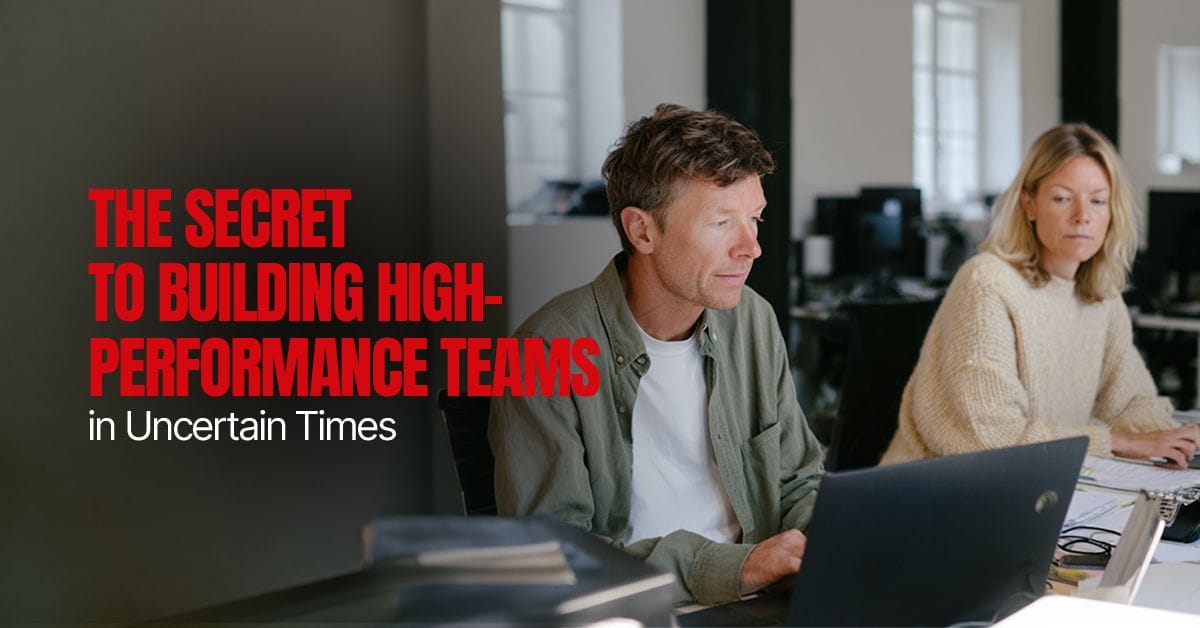
So what is the secret to building high-performance teams in uncertain times?
It starts with conscious leadership.
High Performance Isn’t About Individual Talent
Many leaders make the mistake of believing that high-performance teams are built by hiring the smartest people in the room.
While expertise matters, elite teams are not created through individual brilliance alone.
High-performance teams are characterized by:
- Shared trust
- Psychological safety
- Clear expectations
- Strong communication
- Diverse perspectives
- Collective accountability
- Alignment around a common mission
When these elements are present, something powerful happens: the team enters a state of collective flow.
Ideas build on one another. Collaboration becomes effortless. Team members proactively support each other. Momentum accelerates.
Rather than competing for recognition, individuals become invested in the success of the entire team.
Trust Is the Foundation of Every High-Performance Team
Trust is often discussed but rarely understood.
Trust isn’t built through team-building exercises alone. It’s created when people consistently demonstrate reliability, integrity, and accountability.
In high-performing environments, team members trust that:
- Everyone understands the mission.
- Everyone knows their role.
- Everyone is committed to the collective outcome.
- Everyone will do what they say they’re going to do.
This level of trust creates freedom.
Instead of micromanaging, leaders can focus on strategic growth. Instead of managing conflict, teams can focus on innovation.
When trust is high, performance follows.
Why Self-Awareness Is the Ultimate Leadership Advantage
One of the biggest gaps in leadership today is self-awareness.
Many leaders believe they are highly self-aware, yet research consistently shows that only a small percentage truly are.
Self-awareness is the foundation of emotional intelligence and effective leadership because it allows leaders to:
- Understand how they impact others
- Manage emotions under pressure
- Adapt to changing circumstances
- Receive feedback without defensiveness
- Lead with authenticity
Without self-awareness, leaders often create blind spots that undermine team trust and performance.
With self-awareness, leaders create alignment between what they say, what they do, and how they show up.
And people can feel the difference.
Adaptability: The New Leadership Currency
If there is one skill that separates thriving organizations from struggling ones today, it’s adaptability.
Markets shift.
Strategies change.
Technologies evolve.
Customer expectations transform overnight.
Leaders who cling to old ideas, rigid thinking, or ego-driven decision-making create bottlenecks that slow down their entire organization.
High-performance leaders understand that adaptability is not weakness—it’s strength.
They know how to:
- Pivot quickly when circumstances change
- Embrace new information
- Let go of outdated strategies
- Stay focused on outcomes rather than attachment to methods
In today’s environment, adaptability is no longer a competitive advantage.
It’s a requirement.
The Difference Between a Growth Mindset and a Fixed Mindset
A growth mindset is one of the strongest indicators of future success.
People with a growth mindset believe skills can be developed through effort, feedback, and learning.
People with a fixed mindset believe abilities are static and often resist feedback or change.
In uncertain times, fixed mindsets become organizational liabilities.
Growth-minded individuals:
- Seek feedback
- Embrace challenges
- Learn from setbacks
- Stay curious
- Adapt more quickly
Curiosity is especially important because curiosity and judgment cannot coexist.
When leaders remain curious, they stay open to possibilities, innovation, and growth.
When they become judgmental, learning stops.
Emotional Intelligence Is No Longer Optional
Technical expertise may earn someone a seat at the table.
Emotional intelligence determines whether they can lead effectively once they get there.
High-EQ leaders understand how to:
- Navigate difficult conversations
- Build trust
- Support team development
- Handle conflict constructively
- Inspire engagement
They understand that leadership isn’t about control.
It’s about influence.
And influence is built through connection, empathy, and emotional awareness.
As organizations become more complex, emotional intelligence becomes increasingly valuable because leaders must motivate diverse teams through uncertainty, change, and ambiguity.
Hire for Alignment, Not Just Experience
One of the most common hiring mistakes organizations make is overvaluing credentials while undervaluing alignment.
Experience matters.
But experience alone does not create a high-performance culture.
When evaluating candidates, leaders should assess:
Values Alignment
Do they genuinely connect with the organization’s mission?
Coachability
Are they open to feedback and growth?
Adaptability
Can they navigate change effectively?
Emotional Intelligence
Can they build strong relationships?
Authenticity
Are they showing up as their true selves?
The most successful hires aren’t always the most experienced candidates.
They’re often the candidates whose mindset, values, and behaviors align with the culture you’re trying to create.
The Role of Energy in Leadership
Leadership is about far more than words.
Research consistently shows that the majority of communication is nonverbal.
People don’t just listen to what leaders say.
They pay attention to:
- Energy
- Presence
- Confidence
- Authenticity
- Emotional state
This is why leaders who are deeply aligned with their values and purpose often create stronger influence.
Their energy reinforces their message.
When there is alignment between what leaders believe, what they say, and how they behave, trust naturally increases.
And trust is the foundation of performance.
Building Teams That Thrive Through Change
The future belongs to organizations that can adapt without losing their identity.
That requires leaders who can create environments where people feel:
- Connected to purpose
- Safe to contribute ideas
- Empowered to grow
- Accountable for results
- Supported through challenges
The strongest teams are not those that avoid uncertainty.
They are the teams that learn how to move through uncertainty together.
Final Thoughts
Building a high-performance team in uncertain times isn’t about finding perfect people.
It’s about creating the conditions where people can perform at their best.
When leaders prioritize self-awareness, emotional intelligence, adaptability, trust, and alignment, they create cultures where innovation, resilience, and performance naturally emerge.
The future of leadership belongs to those who can navigate complexity without losing connection—to themselves, their teams, and their purpose.
Because in a world defined by constant change, conscious leadership is no longer a luxury. It’s the competitive advantage. Book a free consultation with us to start your journey towards conscious leadership today.
Your highest potential is my passion, let’s unleash it together!
-Coach Susan

Susan Hobson
CEO & Founder of Elite High Performance Inc | High Performance Leadership Coach
Susan Hobson is a High-Performance Leadership Coach, published author, keynote speaker, and Founder & CEO of Elite High Performance Inc. She co-hosts The Leadership Launchpad Project podcast, ranked the #3 leadership podcast in Canada by Feedspot for two consecutive years. A member of the Forbes Coaches Council, Susan blends neuroscience with her first-hand experience competing at Princeton, Harvard, and in the NWHL to help leaders unlock sustainable peak performance.