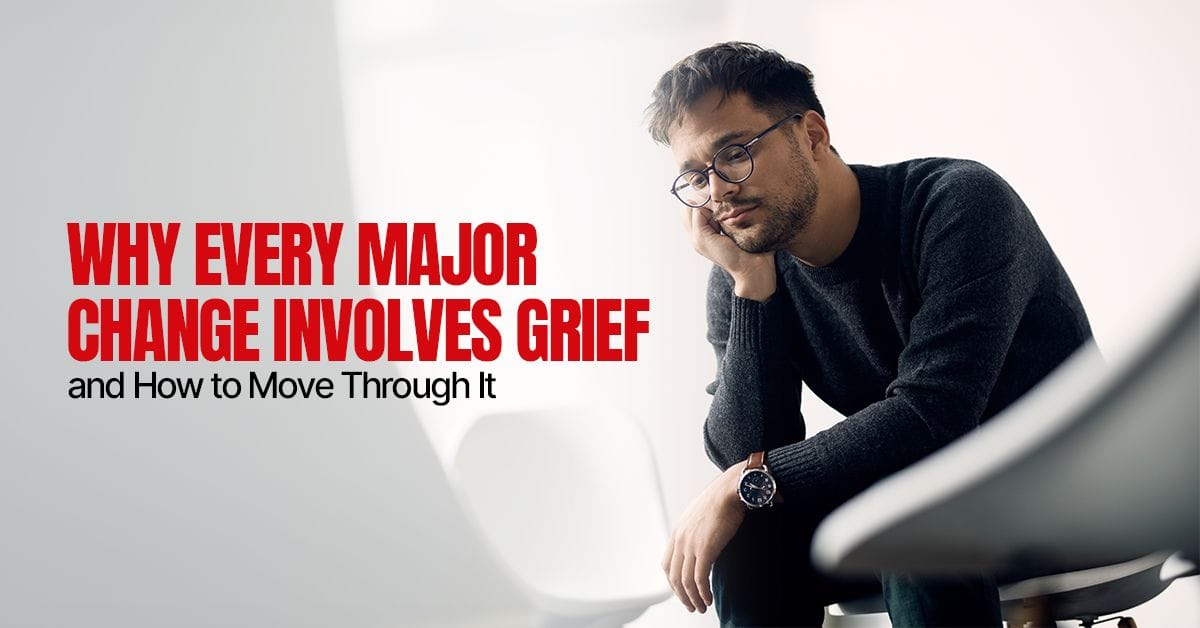
Most people associate grief with the loss of a loved one.
But grief doesn’t begin and end with death.
In reality, grief is the emotional response to any meaningful ending. This can include the end of a relationship, a career, a season of life, a version of yourself, a dream that no longer fits, or an identity you’ve outgrown. Even positive milestones—like becoming a parent, accepting a promotion, moving to a new city, or launching a business—can carry an unexpected emotional weight alongside excitement.
Every significant transformation requires letting go of something familiar before we can fully step into what comes next. And that process of letting go is where grief naturally lives.
This is why every major change involves grief.
At Elite High Performance, we believe conscious leadership is not about avoiding difficult emotions, but about developing the awareness and capacity to move through them with intention. When we begin to understand grief as a natural part of growth rather than something to resist, we stop fighting change and start transforming through it.
Grief Is the Hidden Companion of Change
Every transition creates two internal realities at the same time. One part of us is moving forward into what’s next, while another part is still connected to what is ending. Even when we are excited about the future, the nervous system is still processing familiarity, attachment, and identity.
This is why change can feel emotionally complex, even when it is chosen.
You may find yourself grieving things such as the identity you once held, relationships that no longer align, familiar routines, or expectations that didn’t unfold the way you imagined. Sometimes, you may even grieve a version of life you had deeply envisioned for yourself.
Many high performers overlook these experiences because they don’t appear significant enough to “justify” grief. But grief is not determined by the size of the event. It is determined by the meaning we attach to it.
The deeper the emotional investment, the more significant the internal adjustment.
Why High-Performers Often Struggle With Grief
High-achievers are trained to solve problems, stay focused, and keep moving forward. These traits are powerful in performance environments, but they can become limiting when navigating emotional transitions.
Instead of allowing space to process what they feel, many leaders unconsciously default to staying busy, increasing output, or pushing through discomfort. Others may suppress emotions entirely, telling themselves to move on quickly or questioning why they are still affected.
From a neuroscience perspective, emotional suppression does not remove the experience of grief. Instead, it often keeps the nervous system activated, increasing stress and reducing cognitive clarity over time. When emotions are not processed, the brain continues to signal that something is unresolved, which can impact focus, decision-making, and resilience.
The goal is not to eliminate grief. The goal is to process it in a way that allows integration rather than resistance.
Conscious Leadership Means Becoming Available to Your Experience
One of the core principles of conscious leadership is presence. Presence is the ability to stay aware of what is happening internally without immediately trying to fix, avoid, or override it.
Instead of asking, “How do I stop feeling this?” a conscious leader begins to ask, “What is this experience asking me to understand?”
This shift is subtle, but powerful.
Grief stops being something to escape and becomes something to listen to. It becomes information rather than interference. It becomes part of the learning process rather than a disruption to it.
When emotional awareness increases, reactivity decreases. We begin responding from clarity rather than avoidance.
Grief Doesn’t Follow a Timeline
One of the most common misconceptions about grief is that it follows a predictable or linear path. In reality, grief moves in waves. Some days feel steady and grounded, while others may bring unexpected emotional activation triggered by memories, places, conversations, or even sensory experiences like music or scent.
These moments do not mean you are regressing. They simply indicate that something within you is still integrating.
Healing is not a straight line. It is a layered process where different aspects of an experience surface at different times, each offering an opportunity for deeper understanding and acceptance.
When we stop judging the process, we create more space for it to unfold naturally.
Making Space Instead of Running Away
One of the most important distinctions in emotional resilience is the difference between suppressing emotions and creating space for them. Emotions do not disappear when ignored. They simply remain unprocessed until they are acknowledged.
Leaders who develop long-term resilience are not those who avoid grief, but those who are willing to make space for it when it arises.
That space can take many forms depending on the individual. For some, it may be quiet reflection or journaling. For others, it may be time in nature, meditation, meaningful conversation, coaching, therapy, or spiritual practice. What matters is not the method, but the willingness to be present with what is real.
The purpose of this space is not to stay in grief indefinitely. It is to allow the emotional experience to be acknowledged so it no longer needs to be carried unconsciously in the background.
When emotions are processed, energy is freed. And with that energy, we are able to re-engage more fully with our work, relationships, and purpose.
Grief and Joy Can Exist Together
One of the most transformative realizations in emotional development is that grief and joy are not opposites. They are often present at the same time.
It is possible to miss someone deeply while also feeling gratitude for what they brought into your life. It is possible to feel sadness about an ending while also feeling excitement about what is beginning. It is possible to hold both hope and sorrow in the same moment without contradiction.
This emotional complexity is not confusion. It is a reflection of being human.
In many ways, grief is an expression of love. The depth of grief often reflects the depth of connection. Rather than seeing grief as something to eliminate, we can begin to see it as evidence that something meaningful existed.
From Loss to Legacy
Every ending naturally brings a question with it: what will you carry forward from this experience?
Conscious leadership is not about denying what has changed. It is about choosing how those changes shape who you become.
The people we have loved, the careers we have built, the lessons we have learned, and even the identities we have outgrown do not disappear. They become part of our internal landscape if we choose to integrate them.
Legacy is not only what we leave behind. It is also what we continue to live through our actions, decisions, and values.
It shows up in how we lead, how we communicate, how we show up for others, and how we choose to respond to life moving forward.
This is how transformation becomes embodied. Not by avoiding grief, but by allowing it to deepen our capacity for wisdom, empathy, and purpose.
Final Thoughts
Change is inevitable. Grief is natural. Growth is a choice.
When grief is resisted, it often lingers beneath the surface and quietly drains energy. When it is acknowledged and processed, it becomes a source of insight, clarity, and emotional strength.
Conscious leadership is not about having fewer emotions. It is about becoming more capable of being with them without being controlled by them.
Every meaningful ending carries within it the possibility of a more intentional beginning.
Are you struggling to cope effectively after a significant change, loss or disruption? Book a free consultation to start your conscious leadership journey today.
Your highest potential is my passion, so let’s unleash it together!
-Coach Susan

Susan Hobson
CEO & Founder of Elite High Performance Inc | High Performance Leadership Coach
Susan Hobson is a High-Performance Leadership Coach, published author, keynote speaker, and Founder & CEO of Elite High Performance Inc. She co-hosts The Leadership Launchpad Project podcast, ranked the #3 leadership podcast in Canada by Feedspot for two consecutive years. A member of the Forbes Coaches Council, Susan blends neuroscience with her first-hand experience competing at Princeton, Harvard, and in the NWHL to help leaders unlock sustainable peak performance.