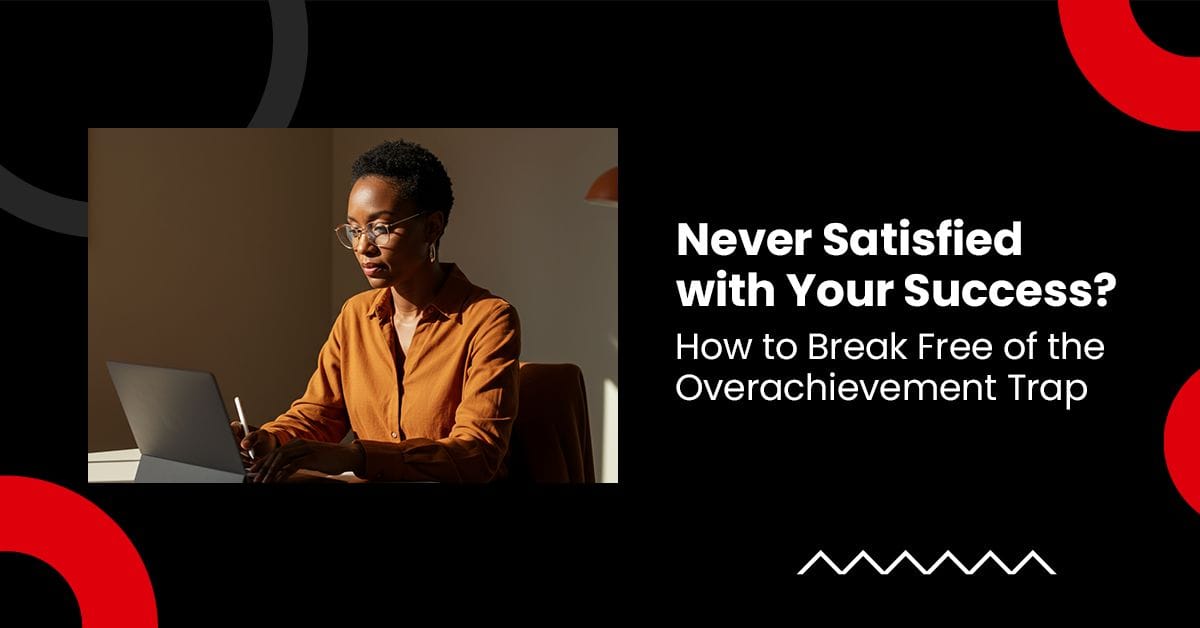
Why Your Wins Don’t Feel Good Enough
I’m curious … Do you ever hit a major goal — only to feel an instant need to move on towards achieving the next big win? That quiet voice inside your head whispering “it’s still not good enough,” is the hallmark of the overachievement trap.
Even when you find yourself at the top of your game, the satisfaction is fleeting. Your brain immediately recalibrates the bar higher, so it can get back to chasing the next big win that will earn them external validation (proving they are good enough, if even for just that moment). This pattern of chronic striving leaves many high-achievers feeling empty, in a deficit, exhausted, and disconnected from the very success they’ve built.
It’s not that ambition is bad — it’s that achievement has become your identity.
What Is the Overachievement Trap?
The overachievement trap is a psychological loop where your self-worth becomes dependent on constant achievement, and thus, the external validation that comes with it. You measure your value not by who you are, but by what you do. You believe “my worth is my work.”
While this mindset can drive impressive results, it often leads to burnout from overachievement, perfectionism, and a persistent feeling that success never feels “good enough.”
At its core, it’s not about success — it’s about safety. You’ve learned to seek validation externally (through praise, metrics, promotions) instead of internally (through the intrinsic validation of purpose, alignment, fulfillment).
What Drives Overachievement?
Overachievement is often born from early conditioning. Somewhere along the way, you learned that love, approval, or safety were earned — not given. This created a subconscious equation:
Achievement = Worthiness.
Common psychological drivers include:
- Fear of failure or rejection — “If I don’t excel, I’ll lose respect.”
- Perfectionism — “If I make no mistakes, I’ll be safe.”
- External validation — seeking praise to feel secure or valued.
- Control — using achievement to manage anxiety or uncertainty.
This mindset fuels chronic striving — the relentless push for more, even when “more” doesn’t make you happier, more satisfied or fulfilled by your efforts.”
Signs You’re Caught in the Trap
You might be caught in the overachievement cycle if you:
- Feel restless or unsatisfied after hitting big goals.
- Struggle to slow down, relax, or celebrate your wins.
- Tie your mood and self-worth to productivity or results.
- Feel guilt when resting or taking time off.
- Experience imposter syndrome despite visible success.
- Push through fatigue, ignoring signs of burnout.
- Believe you’re only as good as your latest win, and thus, must do anything to win (including sacrificing yourself and your mental and physical health.
If this sounds familiar, you’re not alone. Many leaders and high-achievers wrestle with self-worth beyond achievement — learning that outward success doesn’t equal fulfillment.
How It Gets in Our Way (and Pathways Out)
The overachievement trap keeps you on a treadmill — constantly moving, but never arriving. You achieve more yet feel less. The good news? You can learn to break free of the overachievement trap by shifting from external validation to internal fulfillment.
Here’s how:
1. Connect Your Achievement to Its Larger Purpose
When success serves only our ego or approval from the outside world, it feels hollow. Reconnect your achievements to a deeper why. Ask: How does this goal contribute to something meaningful? Purpose transforms effort into fulfillment — it turns striving into thriving.
2. Identify the Underlying Need
Every overachievement pattern hides an unmet emotional need — often belonging, approval, or safety. Instead of pushing harder, get curious: What need am I trying to meet through this goal? Once you name it, you can meet it in healthier, more conscious ways — like connection, rest/recovery, or creative expression.
3. Focus on the Process, Not Just the Result
High achievers often attach joy only to the outcome. The shift? Learning to find satisfaction in the process. Celebrate the daily wins, the growth moments, the lessons learned. This builds internal validation vs external validation, and teaches your nervous system to find peace in progress.
4. Celebrate Your Successes
Overachievers tend to skip the celebration — moving on too fast to “what’s next.” Pause. Reflect. Acknowledge what it took to get here. Celebrating your wins rewires your brain to recognize the proof of progress and combats the “never enough” loop.
Want to Let Go of Your Need to Achieve?
If you’re ready to redefine success — not by how much you do, but by how aligned you feel — this is your moment to conscious choose a new pathway (mindset strategy).
At Elite High Performance, we help high-achievers overcome ‘overachiever syndrome’ and build new mental models for sustainable success.
Our coaching strategies for overachievers are designed to help you:
- Reconnect with your purpose.
- Develop self-worth beyond achievement.
- Rebalance your drive with presence and joy.
- Build sustainable habits that prevent burnout from overachievement.
- Help you find and sustain your flow (peak state).
- Learn how to align with the intrinsic validation of your values, which enhance resiliency and a sense of fulfilment.
Because at the end of the day, true high-performance isn’t about chasing more — it’s about becoming and bringing more of your whole self to your performance.
Your highest potential IS my passion, so let’s unleash it together!
-Coach Susan

Susan Hobson
CEO & Founder of Elite High Performance Inc | High Performance Leadership Coach
Susan Hobson is a High-Performance Leadership Coach, published author, keynote speaker, and Founder & CEO of Elite High Performance Inc. She co-hosts The Leadership Launchpad Project podcast, ranked the #3 leadership podcast in Canada by Feedspot for two consecutive years. A member of the Forbes Coaches Council, Susan blends neuroscience with her first-hand experience competing at Princeton, Harvard, and in the NWHL to help leaders unlock sustainable peak performance.