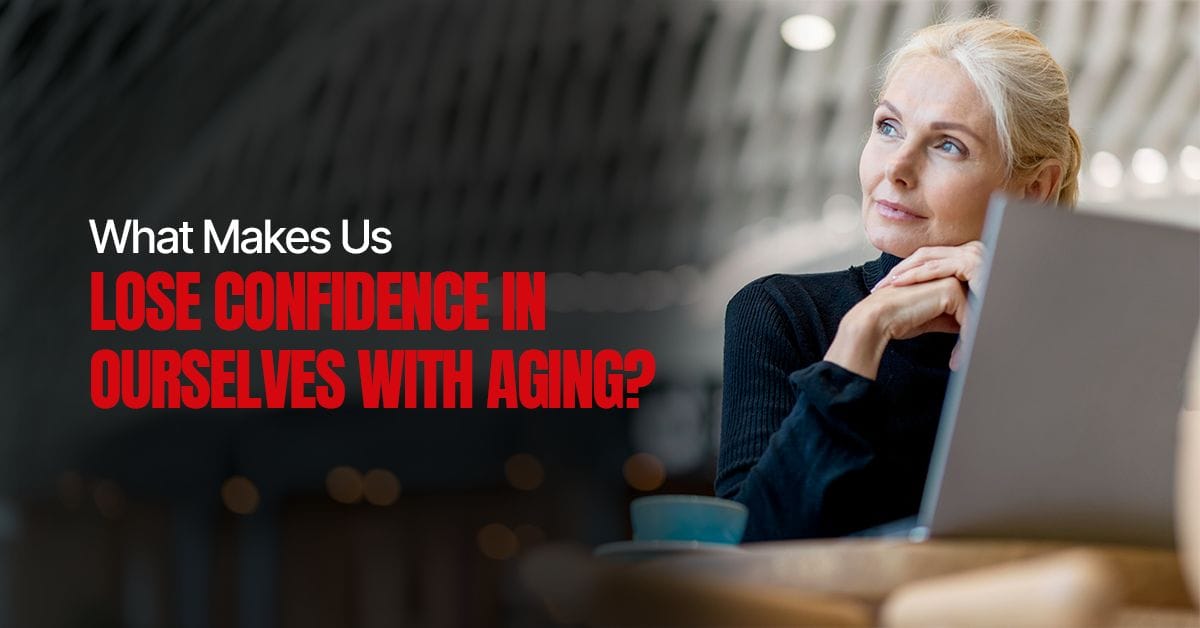
Losing confidence as we age can happen when life transitions – physical changes, accumulated setbacks, shifting roles, social comparison, and changes in our sense of identity begin to influence how we see ourselves.
Aging itself does not automatically cause low self-confidence. Instead, our confidence can decline when we start questioning our abilities, focusing more heavily on past mistakes, feeling less relevant, or allowing fear and self-doubt to shape our decisions.
The encouraging part is that confidence issues can be fixed – by understanding the beliefs and patterns influencing our self-perception, we can intentionally rebuild confidence at virtually any stage of life.
As we grow older, we gain experience, knowledge, perspective, and resilience. So why can confidence sometimes move in the opposite direction?
The answer often has less to do with age itself and more to do with what happens internally as our lives, responsibilities, relationships, bodies, and identities evolve.
Why Can Confidence Decrease With Age?
Confidence is influenced by the way we interpret ourselves and our experiences.
Throughout life, the brain continuously learns from what happens around us. Experiences of success can reinforce a sense of capability, while repeated criticism, rejection, failure, comparison, or uncertainty can influence the beliefs we hold about ourselves.
Over time, these beliefs can become powerful internal narratives:
“Maybe I’m not as capable as I used to be.”
“I should be further ahead by now.”
“It’s too late for me to change.”
“What if I fail?”
When those thoughts are repeated often enough, they can influence behavior. We may hesitate before taking opportunities, avoid challenges, become overly concerned about mistakes, or seek reassurance before making decisions.
The result can become a cycle: self-doubt leads to avoidance, avoidance limits opportunities to experience growth and mastery, and that lack of evidence reinforces self-doubt.
Breaking that cycle starts by recognizing what is actually driving it.
1. Your Identity May Be Changing
One of the biggest reasons confidence can shift with age is identity.
Much of our identity can become connected to external roles: our career, relationships, parenting responsibilities, athletic ability, appearance, achievements, or social status.
But roles change.
Children grow up. Careers evolve. Relationships change. Athletic performance may look different. Retirement may arrive. Priorities can shift dramatically.
When a role that once provided meaning or validation changes, we can find ourselves asking:
Who am I now?
That question can feel uncomfortable, but it can also become an opportunity to build an identity based less on external validation and more on values, purpose, strengths, and self-awareness.
2. Past Experiences Can Shape Present Confidence
Experience usually brings wisdom. But experience can also bring emotional baggage.
A difficult career experience, failed relationship, financial setback, injury, rejection, or major mistake may become part of the way we evaluate future situations.
Instead of thinking, “That didn’t work, so what can I learn?” we may begin thinking, “That didn’t work because I’m not capable.”
Those are very different interpretations.
Confidence grows when we learn to separate an unsuccessful outcome from our identity.
You can fail at something without being a failure.
3. Comparison Can Become More Powerful
Comparison does not disappear as we get older. It simply changes form.
We might compare careers, income, relationships, appearance, health, parenting, retirement savings, achievements, or perceived success.
Social media can amplify this because we are often comparing the complexity of our own lives with carefully selected moments from someone else’s.
Eventually, the question changes from:
“Am I living according to what matters to me?”
to:
“Am I doing as well as everyone else?”
That shift can quietly undermine self-confidence.
Building sustainable confidence requires returning to your own values, goals, and definition of success.
4. Fear of Failure Can Increase
When we are younger, mistakes may feel like part of learning.
Later in life, we may believe we should already know better.
This can create perfectionism and make mistakes feel more threatening. We may become less willing to try something unfamiliar because we don’t want to appear inexperienced or unsuccessful.
Ironically, protecting ourselves from failure can also prevent the experiences that build confidence.
Confidence isn’t the certainty that you will succeed.
It is the belief that you can respond, learn, and move forward even when things don’t go according to plan.
5. Physical Changes Can Affect Self-Perception
Aging naturally brings physical changes, and those changes can influence confidence—especially in cultures that heavily associate youth with attractiveness, energy, relevance, or capability.
For athletes and highly active individuals, changes in speed, recovery, strength, or performance can be particularly challenging when physical ability has been an important part of identity.
The goal isn’t to pretend these changes don’t exist.
It is to avoid allowing one changing part of yourself to determine the value of your whole self.
Your worth is larger than your appearance, productivity, title, or physical performance.
6. Burnout Can Look Like Lost Confidence
Sometimes what feels like a confidence problem is actually exhaustion.
High-performers may spend years operating under intense expectations. They continually achieve, solve problems, support other people, and move toward the next goal without creating enough space for recovery.
Eventually, mental and emotional fatigue can make even familiar challenges feel overwhelming.
You might think:
“Why can’t I handle this anymore?”
But the better question may be:
“What does my brain and body need in order to perform sustainably?”
Rest and recovery aren’t signs that you’ve lost your edge. They are part of maintaining it.
How the Brain Influences Self-Confidence
Our brains are remarkably adaptable.
Through neuroplasticity, the brain can change and reorganize in response to experiences and learning throughout life. This matters because many patterns connected to confidence—how we respond to setbacks, interpret challenges, or speak to ourselves—can be strengthened through repetition.
If you repeatedly tell yourself, “I’m not capable anymore,” that thought can become familiar.
But familiar doesn’t mean factual.
You can intentionally begin challenging automatic thoughts and replacing them with questions such as:
What evidence do I have for this belief?
What would I tell someone else in this situation?
What have I successfully navigated before?
What could this experience teach me?
The objective isn’t forced positive thinking. It is developing a more accurate, constructive relationship with yourself.
How to Rebuild Confidence as You Get Older
Rebuilding confidence begins with action, not perfection.
Start by noticing the internal narratives that influence your decisions. Identify where you are avoiding challenges because of fear, comparison, or self-doubt.
Then create opportunities for small wins.
Try something new. Develop a skill. Set a meaningful goal. Have the conversation you’ve been avoiding. Ask for support. Celebrate progress instead of waiting for perfection.
Most importantly, reconnect with your values.
Ask yourself:
What matters to me now—not ten years ago, not according to someone else’s expectations, but today?
Confidence becomes more sustainable when it is rooted in alignment rather than approval.
Aging doesn’t have to mean becoming less confident. It can become an opportunity to build a deeper kind of confidence—one grounded in experience, self-awareness, resilience, purpose, and the knowledge that you can continue growing.
At Elite High Performance, we believe sustainable performance begins from within. Neuroscience-backed coaching can help leaders, professionals, athletes, and high performers identify the mindset patterns holding them back, strengthen emotional resilience, reconnect with purpose, and develop the internal confidence required for their next chapter. Book a free consultation to start building sustainable confidence in your self-leadership.
Because confidence isn’t about becoming the person you used to be.
It’s about trusting the person you’re becoming.
Your highest potential is my passion, so let’s unleash it together!
-Coach Susan

Susan Hobson
CEO & Founder of Elite High Performance Inc | High Performance Leadership Coach
Susan Hobson is a High-Performance Leadership Coach, published author, keynote speaker, and Founder & CEO of Elite High Performance Inc. She co-hosts The Leadership Launchpad Project podcast, ranked the #3 leadership podcast in Canada by Feedspot for two consecutive years. A member of the Forbes Coaches Council, Susan blends neuroscience with her first-hand experience competing at Princeton, Harvard, and in the NWHL to help leaders unlock sustainable peak performance.
Frequently Asked Questions
Why am I losing confidence as I age?
What are the causes of a lack of self confidence?
For some people, confidence becomes overly dependent on external achievements or approval. When circumstances change, their sense of self-worth changes with them. Developing confidence from internal values, skills, resilience, and self-trust can create a more sustainable foundation.
What are some signs that I've lost self-respect?
A difficult period does not necessarily mean you have “lost” your self-respect. Instead, these patterns can be signals that it’s time to reconnect with your boundaries, values, needs, and sense of identity.
How to cure low self-esteem?
Coaching can help people address mindset patterns, clarify goals, and develop confidence and performance strategies. When persistent low self-esteem is connected with significant emotional distress, anxiety, depression, trauma, or difficulty functioning in daily life, support from a qualified mental health professional may also be appropriate.
Ultimately, rebuilding self-esteem is less about becoming perfect and more about learning to trust yourself again.